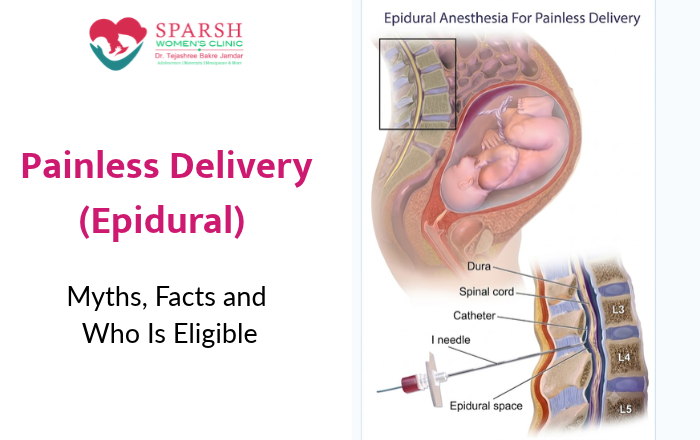
“Painless delivery” is one of the most searched phrases by expecting mothers, and also one of the most misunderstood. The term usually refers to a labour epidural, a method of pain relief given during labour. Most women who ask about it have the same questions: Is it harmful for the baby? Will it cause back pain later? Can everyone have it?
This guide separates common myths from facts, explains how an epidural works in general terms, and describes who may be eligible. It is for information only. Whether an epidural suits you is decided by your obstetrician and the anaesthetist, after looking at your health, your pregnancy and how your labour is progressing.
An epidural for labour is a pain relief method in which an anaesthetist places a thin tube (catheter) in the lower back, close to the nerves that carry labour pain. Medicine is then given through this tube to reduce pain from the contractions. The mother usually stays awake and can take part in the birth.
“Painless” is a popular way of describing it, but the response differs from woman to woman. Some feel a great deal of relief. Others still notice pressure, tightness or some pain. Calling it pain relief, rather than a pain-free labour, is more accurate.
Fact: Back pain after pregnancy is common, and it often comes from the changes the body goes through during pregnancy and birth. Studies have not shown that an epidural is the reason for long-term backache. Mild soreness at the injection site for a few days is possible.
Fact: Research has not found that an epidural by itself raises the chance of a caesarean delivery. Labour can change course for many reasons, and your doctor will decide on the mode of delivery based on you and your baby.
Fact: Small amounts of medicine can reach the baby, and your doctors monitor both of you during labour. Any possible effects and risks are explained to you by the team before the procedure.
Fact: Many women can still feel the urge to push, though it may be less strong. The team guides you, and the level of numbness can be adjusted.
Fact: Serious nerve problems are very rare. Temporary heaviness or weakness in the legs is more common and usually passes after the medicine wears off. This is one reason a trained anaesthetist performs and monitors the procedure.
Fact: In some women the later part of labour may take a little longer. This is not the same for everyone, and your doctor will watch your progress.
Fact: Any woman who is eligible and wants pain relief can discuss it, whether it is her first baby or not.
Like any medical procedure, an epidural has possible side effects. Your anaesthetist will explain these in detail. They may include:
An epidural does not remove all sensations, it does not suit every labour, and it cannot be started in every situation. That is why a conversation before labour begins is useful.
Eligibility is a medical decision. Your obstetrician and the anaesthetist will look at your health history, the stage of labour and any pregnancy complications. They usually consider the following.
This list is not complete, and it cannot replace an assessment. Many women are advised to meet the anaesthetist or ask about the option during antenatal visits, so that there are no surprises on the day.
You can also read about normal delivery care in Mulund West and the clinic’s painless delivery information page.
1. Is a painless delivery the same as an epidural?
The phrase “painless delivery” is commonly used for a labour epidural, though other pain relief methods exist. Your doctors will explain which options apply to you.
2. Will I feel nothing at all?
Not necessarily. Many women feel less pain but still notice pressure or tightness. The effect varies from person to person.
3. Can I choose an epidural before labour starts?
You can discuss your preference in advance. Whether it can be given depends on your health, the stage of labour and the decision of the doctor and anaesthetist.
4. Is an epidural possible after a previous C-section?
This depends on your history and the plan for delivery. Your obstetrician and anaesthetist will advise you.
5. Will it affect breastfeeding?
Most mothers are able to breastfeed after an epidural. If you have concerns, ask your doctor or the nursing team for support.
6. When should I speak to my doctor about it?
The antenatal visits during the later months are a good time, so your questions can be answered well before labour begins.
If you are planning your delivery and want to understand your pain relief options, you can consult Dr. Tejashree Bakre, Gynecologist Obstetrician and Laparoscopic Surgeon (MBBS, MS – Obstetrics & Gynaecology), with 14+ years of experience. She will discuss your health and your pregnancy, and explain whether an epidural may be suitable, along with the anaesthetist.
In an emergency, please go to the nearest hospital directly. You can also reach the team through the contact page.
Mulund West: Dr. Tejashree Bakre, Mulund West
Address: 2nd Floor, Rohini Residency, Maple Polyclinic, Cabin D, 201, B Wing, MG Road, near Panch Rasta, Mulund West, Mumbai, Maharashtra 400080
Phone: 70455 63438
Bhandup West: Dr. Tejashree Bakre, Bhandup West
Address: 1st Floor, Crosswinds CHSL, Pancharatna Society, Vedant Hospital, Cabin No. 3, B Wing, Jangal Mangal Rd, Gadhav Naka, Gate, Bhandup West, Mumbai, Maharashtra 400078
Phone: 70455 63438
This article is for general information and does not replace medical advice.

Dr. Tejashree Bakre is a consultant Obstetrician, Gynecologist, and Laparoscopic Surgeon practicing in Mulund & Bhandup, Mumbai, with over 14+ years of experience specializing in high-risk pregnancies, advanced minimally invasive surgeries, and comprehensive women’s healthcare.
Cabin D, 201, B Wing, 2nd Floor, Rohini Residency, M.G. Road, Near Panch Rasta, Mulund West, Mumbai – 400080.
3rd Floor Marathon Millennium Lal Bahadur Shastri Marg, besides, Nirmal Lifestyle Rd, Mulund West, Mumbai, Maharashtra 400080
B Wing, 1st Floor, Crosswinds CHSL, Pancharatna Society, Jangal Mangal Rd, opp. Sarvoday Nagar, Satyavijay Society, Gadhav Naka, Gate, Bhandup West, Mumbai, Maharashtra 400078
Tulsi Pipe line Road, Veena Nagar Phase-II, Veena Nagar, Mulund West, Mumbai, Maharashtra 400080
Copyright © 2026 All Rights Reserved Website Design By DMXDIGITAL
WhatsApp us