Trying to conceive can become confusing when you are told about different fertility treatments such as IUI and IVF. Both can help with pregnancy, but they work in very different ways and are suitable for different fertility situations.
So, IUI vs IVF, which one is better?
There is no single answer. The right treatment depends on factors such as your age, ovarian reserve, ovulation, fallopian tube health, sperm quality, how long you have been trying to conceive, and the underlying cause of infertility.
Understanding the difference between IUI and IVF can help you have a more informed discussion with your gynecologist or fertility specialist.
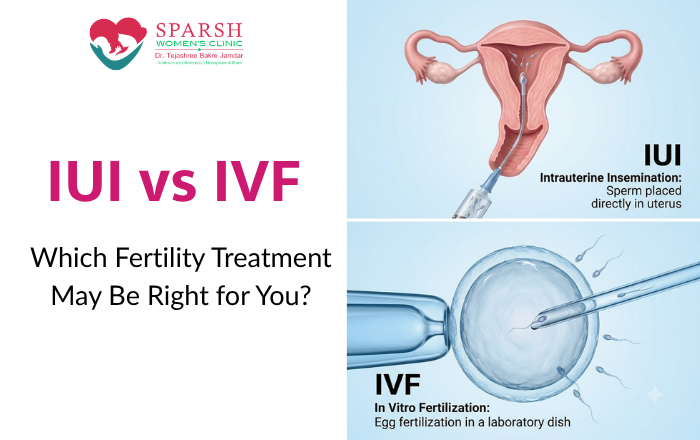
IUI, or intrauterine insemination, is a fertility treatment in which prepared sperm is placed directly into the uterus around the time of ovulation.
Before the procedure, sperm is processed in the laboratory to concentrate the healthier, more motile sperm. The prepared sperm is then introduced into the uterus using a thin catheter.
Fertilization still takes place naturally inside the body. In some cases, medicines may be used to stimulate ovulation and increase the number of follicles that develop.
IUI is generally less invasive and less costly than IVF, but its success depends heavily on factors such as age, ovulation, sperm quality and whether the fallopian tubes are open.
A doctor may consider IUI in situations such as:
IUI generally requires at least one functioning fallopian tube because fertilization occurs inside the body.
IVF, or in vitro fertilization, is a fertility treatment in which eggs are collected from the ovaries and fertilized with sperm in a laboratory.
The basic IVF process usually involves:
Unlike IUI, fertilization in IVF takes place outside the body.
IVF can be used for a wide range of fertility problems and gives the fertility team more control over fertilization and embryo selection.
The biggest difference is where fertilization takes place.
With IUI, prepared sperm is placed into the uterus and fertilization occurs naturally inside the reproductive tract.
With IVF, eggs are retrieved from the ovaries and fertilized in a laboratory before an embryo is transferred into the uterus.
| Factor | IUI | IVF |
|---|---|---|
| Full form | Intrauterine insemination | In vitro fertilization |
| Where fertilization occurs | Inside the body | In a laboratory |
| Egg retrieval | No | Yes |
| Embryo created in laboratory | No | Yes |
| Procedure | Less invasive | More involved |
| Cost | Generally lower | Generally higher |
| Success per treatment cycle | Generally lower than IVF | Generally higher than IUI |
| Fallopian tubes | Usually at least one open tube is needed | Blocked tubes can often be bypassed |
| Common use | Mild or unexplained fertility problems in selected patients | A wider range of fertility problems |
The actual chance of pregnancy varies considerably between individuals. Age, egg and sperm quality, diagnosis and treatment history all influence outcomes. IUI is generally less successful per cycle than IVF, although it may be an appropriate first step for some patients.
In general, IVF has a higher success rate per treatment cycle than IUI. However, that does not mean IVF is automatically the best first treatment for everyone.
For example, a younger person with regular ovulation, open fallopian tubes and mild sperm-related infertility may be a reasonable candidate for IUI.
On the other hand, someone with blocked fallopian tubes or certain severe fertility problems may need IVF rather than spending time on treatments that are unlikely to work.
Success rates also differ between clinics and patient groups, so it is better to discuss your individual expected outcome with a fertility specialist rather than relying on a single percentage found online.
IUI may be considered when the fertility problem is relatively mild and the basic conditions needed for natural fertilization are present.
Your doctor may consider IUI when:
For unexplained infertility, treatment plans can vary. The American Society for Reproductive Medicine notes that a limited course of ovarian stimulation with oral medication and IUI is commonly used before moving to IVF in many patients, while age and other factors can change the approach.
IVF may be considered when there is a higher likelihood that IUI will not be successful or when IVF offers a more suitable route to pregnancy.
Examples include:
The exact recommendation depends on the individual’s fertility evaluation.
For some patients, moving directly to IVF can also be considered instead of spending several cycles on IUI, particularly when age or other fertility factors make time more important.
IUI is generally a simpler procedure than IVF, but it is not completely risk-free.
When fertility medicines are used with IUI, there can be an increased risk of developing multiple follicles and therefore a multiple pregnancy. This is one reason monitoring is important during stimulated IUI cycles.
IVF involves ovarian stimulation and egg retrieval, so it has additional considerations. One potential complication of fertility medicines is ovarian hyperstimulation syndrome (OHSS), in which the ovaries respond excessively to stimulation.
Symptoms that can require prompt medical attention include:
If these symptoms occur during fertility treatment, contact your fertility clinic or doctor promptly.
The decision should not be based only on which treatment is cheaper, easier or has a higher success rate.
Your doctor may consider several factors before recommending IUI or IVF:
Age is an important factor in fertility because egg number and egg quality generally decline with age. The impact of age can influence whether it makes sense to try IUI first or consider IVF sooner.
Tests such as AMH and antral follicle count may provide information about ovarian reserve. These results are interpreted along with your age, medical history and other fertility findings.
If the fallopian tubes are blocked, sperm and egg may not be able to meet naturally. Since IUI relies on fertilization occurring inside the body, blocked tubes can make IUI unsuitable. IVF can bypass the fallopian tubes.
Semen analysis helps assess sperm count, movement and other characteristics. Mild sperm problems may sometimes be managed with IUI, while more significant male-factor infertility may require IVF with additional laboratory techniques when appropriate.
Irregular or absent ovulation can affect natural conception. Depending on the cause, your doctor may first recommend ovulation treatment, IUI or another approach.
If previous IUI cycles have not resulted in pregnancy, your doctor may reassess the situation and discuss whether continuing IUI or moving to IVF makes more sense.
For some people, trying a less invasive treatment first is reasonable. For others, particularly when age or certain fertility factors are involved, moving to IVF sooner may be discussed.
Yes. Many people start with IUI and move to IVF if IUI does not result in pregnancy or if their fertility evaluation suggests that IVF is more appropriate.
There is no universal number of IUI attempts that applies to everyone. The decision depends on age, diagnosis, ovarian reserve, sperm factors, previous treatment results and other individual circumstances.
For some patients with unexplained infertility, a limited number of stimulated IUI cycles may be tried before IVF.
No. IVF does not guarantee pregnancy or a live birth.
Although IVF is one of the most effective fertility treatments for many causes of infertility, outcomes vary from person to person.
Factors such as age, embryo development, egg and sperm quality, uterine health and the underlying cause of infertility can influence the outcome.
A fertility specialist can explain the expected chances based on your individual circumstances rather than relying on general success rates.
1. Is IUI better than IVF?
Neither treatment is universally better. IUI may be suitable for selected patients with less complex fertility problems, while IVF may be recommended when there are more significant fertility factors or when IUI is unlikely to work.
2. Is IVF more successful than IUI?
Generally, IVF has a higher success rate per treatment cycle than IUI. However, individual outcomes vary significantly based on age, diagnosis, egg and sperm quality and other factors.
3. How many IUI cycles should you try before IVF?
There is no fixed number for everyone. In some cases of unexplained infertility, doctors may recommend around three or four cycles of stimulated IUI before considering IVF, but age and individual fertility factors can change this plan.
4. Can IUI work if the fallopian tubes are blocked?
Usually, IUI requires at least one functioning fallopian tube because fertilization needs to occur inside the reproductive tract. If both tubes are blocked, IVF may be recommended because fertilization takes place outside the body.
Have questions? We’re just a message away! Contact us on WhatsApp — Click Here to Chat with Us
Choosing between IUI and IVF is a personal medical decision. What works for one person may not be the right approach for another.
If you are having difficulty conceiving or are unsure whether IUI or IVF is appropriate for you, consider discussing your options with Dr. Tejashree Bakre, Gynecologist & Obstetrician, with 14+ years of experience, available at Maple Polyclinic, Elite Women & Child Care Hospital, Apex Hospitals, Mulund West, and Vedant Hospital, Bhandup West.
A consultation can help you understand the possible cause of fertility difficulties, what tests may be useful, and whether IUI, IVF or another treatment approach may be suitable for your situation.
Name – Dr. Tejashree Bakre, Gynecologist Obstetrician and Laparoscopic Surgeon
Address: 2nd Floor, Rohini Residency, Maple Polyclinic, Cabin D, 201, B Wing, MG Road, near Panch Rasta, Mulund West, Mumbai, Maharashtra 400080
Phone: 70455 63438

Dr. Tejashree Bakre is a consultant Obstetrician, Gynecologist, and Laparoscopic Surgeon practicing in Mulund & Bhandup, Mumbai, with over 14+ years of experience specializing in high-risk pregnancies, advanced minimally invasive surgeries, and comprehensive women’s healthcare.
Cabin D, 201, B Wing, 2nd Floor, Rohini Residency, M.G. Road, Near Panch Rasta, Mulund West, Mumbai – 400080.
3rd Floor Marathon Millennium Lal Bahadur Shastri Marg, besides, Nirmal Lifestyle Rd, Mulund West, Mumbai, Maharashtra 400080
B Wing, 1st Floor, Crosswinds CHSL, Pancharatna Society, Jangal Mangal Rd, opp. Sarvoday Nagar, Satyavijay Society, Gadhav Naka, Gate, Bhandup West, Mumbai, Maharashtra 400078
Tulsi Pipe line Road, Veena Nagar Phase-II, Veena Nagar, Mulund West, Mumbai, Maharashtra 400080
Copyright © 2026 All Rights Reserved Website Design By DMXDIGITAL
WhatsApp us